
Austin's Light-Rail Plan Is Moving Forward — Here's Why It Should Be on Every Home-buyer's Radar

Austin's Light-Rail Plan Is Moving Forward — Here's Why It Should Be on Every Home-buyer's Radar
Most people know that I’m a real estate agent. A lot of them don’t know that I’m also a landlord and Airbnb host (actually a “Superhost” if I may toot my own horn for a second). That extra layer means I’m always approaching home-buying with a strategic POV.When I work with a new client, one of the first things I ask is: what are your long-term intentions? Because if part of your goal is building wealth — through renting, short-term hosting, or simply smart appreciation — then we need to add some factors to your needs list that go beyond the obvious.Walkability, for example. You personally might not care about it. But a future renter or buyer? They probably will.Which brings me to what I want to go over this week: Austin’s new light-rail plan.
Photo by Dale Honeycutt on Unsplash
What’s Actually Happening
The Austin Transit Partnership (ATP) recently released a Draft Environmental Impact Statement — a 16,000-page document (yes, really) that maps out the most detailed vision yet for Austin’s planned light-rail system.
Here’s what the plan looks like right now:
-
A 9.8-mile route with 15 stations, running north to 38th Street, east toward Ben White and Riverside, and south to Oltorf Street
-
Electric trains running every 5 - 10 minutes
-
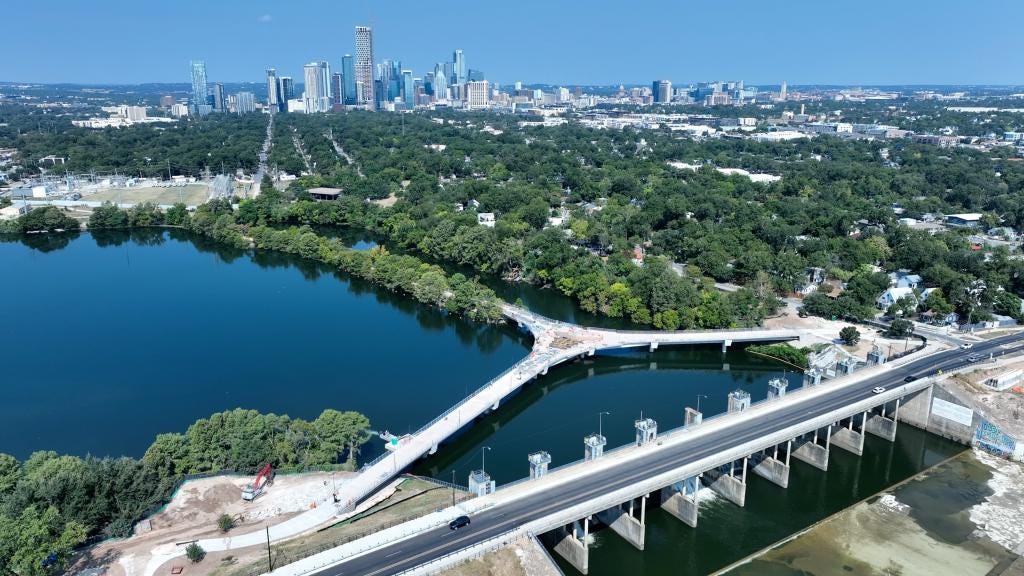
An elevated bridge over Lady Bird Lake with pedestrian and bike paths
-
Tree-lined pathways along Riverside Drive
-
Park-and-ride facilities at key end-points (38th & Guadalupe, Oltorf, and Yellow Jacket Lane)
-
Construction potentially starting in 2027, with the system open to riders by 2033
This is the largest transit infrastructure project in Austin history. And the blocks around those 15 stations are worth paying attention to.

Property values near transit tend to rise. This is well-documented across cities that have built rail. ATP’s own report projects that the light-rail system will boost property values near stations. More access to the city without a car tends to attract demand — which tends to support appreciation.
Rental appeal gets stronger. If you’re buying with any eye toward future rental income, proximity to transit is one of the most consistent drivers of rental demand. Tenants, particularly in a city like Austin, increasingly prioritize the ability to get around without relying entirely on a car.
The Riverside corridor gets more connected. The elevated section along Riverside Drive, combined with new pedestrian and bike infrastructure, could meaningfully change how that corridor functions — and how it’s valued. If you’ve been watching East Riverside or the areas around Oltorf, this is relevant context.
Job growth follows transit. The report notes that businesses along the corridor gain access to a larger workforce. That tends to anchor commercial activity — which is good for the neighborhoods around those stations.
Let’s take a closer look, because there is some uncertainty here.
Legal and legislative challenges. Lawsuits have been filed against the project — one questioning ATP’s authority to issue bonds using city tax revenue, and another arguing a miscalculation in the property tax rate. The Texas Legislature has also previously attempted to strip ATP of its bonding authority, and a similar effort could resurface.
Construction creates short-term disruption. The project would remove more than 600 on-street parking spaces (mostly from Guadalupe, Lavaca, and South Congress), displace up to 71 businesses, and require years of active construction. If you’re buying immediately adjacent to the route, factor that in.
Nothing is guaranteed until it’s built. The 2033 opening is still contingent on federal funding, legal clearance, and legislative stability. It’s a strong trajectory, but it’s not a done deal.
What This Means for You
Take note here, whether you’re a buyer, an owner, or someone thinking about investing:
If you’re buying now and thinking long-term: Station proximity is worth adding to your evaluation criteria. Homes and properties within walking distance of planned stations tend to get ahead of the appreciation curve — before the ribbon-cutting, not after. You don’t need to buy right next to the tracks. But knowing where those 15 stations will be is useful.
If you’re thinking about future rental potential: A property that’s a 10-minute walk from a light-rail station becomes a more compelling rental in 2033 than it might seem today. If that aligns with your goals, you should factor it into your search now.
If you already own near the route: You don’t necessarily need to do anything. But it may be worth a conversation about how the long-term trajectory of your neighborhood is shaping up (from a value standpoint and a lifestyle standpoint).
If you're cautious about the uncertainty: That's reasonable. Go in with eyes wide open. Don't buy a property solely because of the light-rail. But don't ignore it either. Use it as one data point in a bigger picture.
Austin’s growth trajectory with jobs, population, and housing demand has always pointed toward the need for more mobility options. The question was never really “if” transit would expand, but “when” and “how.”
The areas this route touches already have a lot going for them: established neighborhoods, strong rental demand, walkable nodes, and access to employment centers. The light-rail, if it gets built on schedule, layers additional long-term value onto corridors that were already moving in an interesting direction.
And even with the legal uncertainty, the direction of this project has been consistent for years. The DEIS is a significant milestone. Federal funding is tied to it. The political will exists at the city level. That doesn’t mean it’s a sure thing — but it does mean it’s worth taking seriously.
Austin’s light-rail plan just got a detailed roadmap. Fifteen stations. A 9.8-mile route. Bike and pedestrian infrastructure woven in. And a projected timeline that puts riders on trains in about 7 years from now.
Whether you’re buying your first home, your next investment property, or simply thinking about what your current home might be worth in ten years — this is information worth having.
If you want to talk through where the stations are, what neighborhoods fall within walking distance, or how to factor transit access into your buying strategy, I’m here.

Sources: Austin Transit Partnership Draft Environmental Impact Statement (released January 2025); KUT 90.5 reporting by Nathan Bernier
Recent Posts